
Find recurring needs
See the themes customers raise across conversations.
Bring recurring needs, concerns and competitor mentions from sales conversations into a useful view for the wider business.
See the themes customers raise across conversations.
Understand objections and friction in the context in which customers describe them.
Give marketing, product and leadership evidence to discuss alongside other research.
Sales teams hear questions and concerns that never reach a formal research report. Market Intelligence makes those themes easier to explore, so marketing, product and leadership can bring customer language into their decisions.
Explore practical use casesExplore problems and desired outcomes that appear across the available conversations.
Review competitor mentions and the criteria customers use when comparing options. A mention alone does not establish a win or loss.
Look for repeated concerns about price, implementation, confidence or fit and inspect the source context.
Use conversation examples to frame a question for marketing or product, alongside other research and commercial evidence.
Real demo-account screens. Explore the detail behind the workflow.
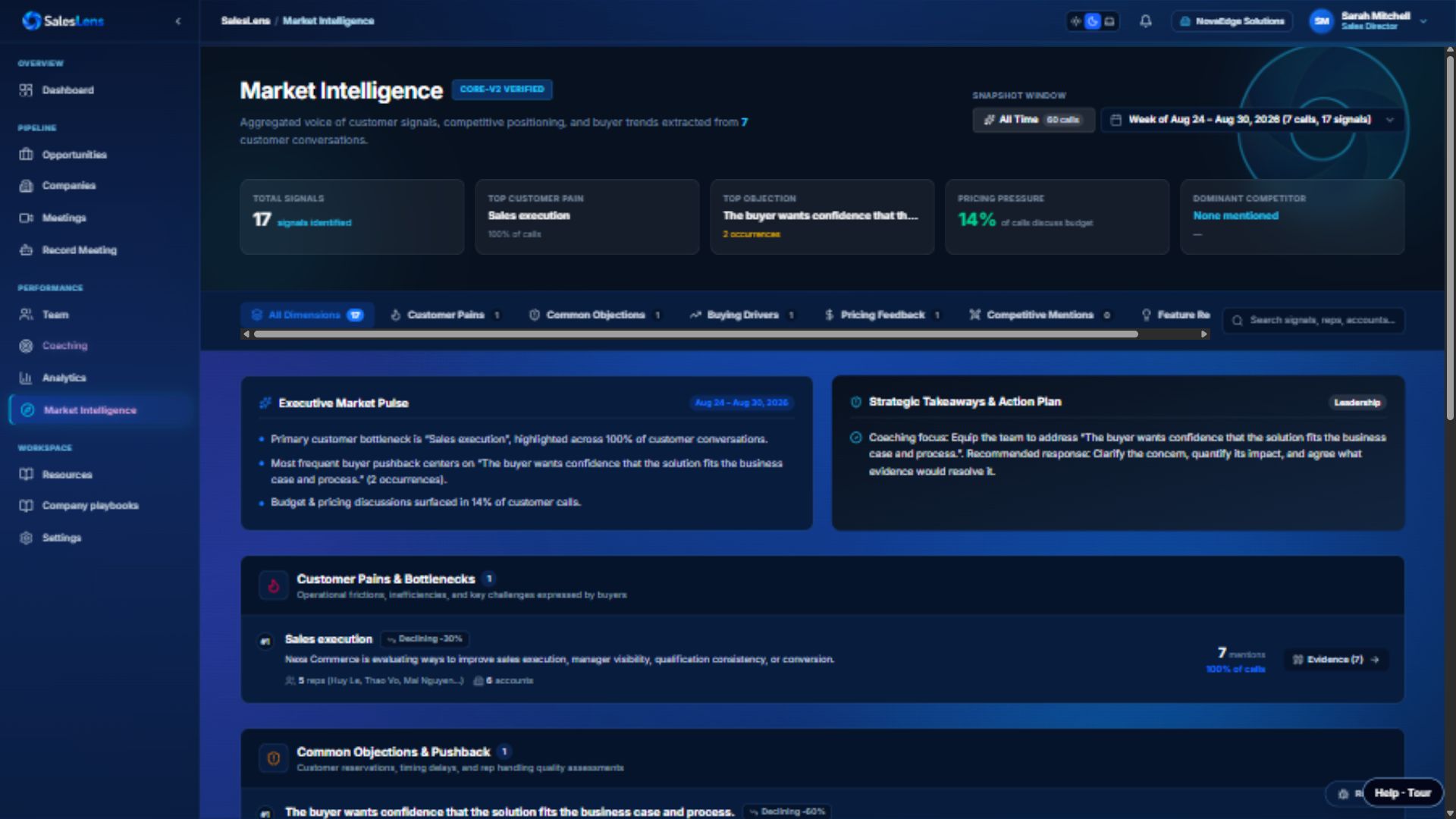
The pattern may reveal unclear positioning or a genuine service need.
Illustrative situations showing how to put the feature to work.
Customers repeatedly misunderstand what implementation includes.
Review the conversations and compare the customer’s questions with the current website and sales materials.
Identify a specific explanation to clarify across the customer journey.
Several prospects ask for a capability the team does not currently offer.
Read the underlying problem, affected workflow and urgency before passing a feature request to product.
Give product teams a better-framed research question rather than a list of feature names.
Use these outcomes to guide your team’s review and assess whether the workflow is helping.
Check whether revised materials answer the questions customers actually ask.
Bring problem context and source examples into prioritisation.
Connect sales observations with wider business reviews.
Begin with a representative set of conversations and check which segments are covered. Treat themes as evidence to investigate, not a complete survey of the market.
No. It reflects the conversations available to SalesLens. Use it alongside other research and consider which customers and teams are represented.
Use the available evidence links to review the conversation context behind a theme.
Turn recorded meetings into a clear summary of customer needs, buying intent, qualification gaps and next steps—with evidence you can return to.
Explore featureBring meetings, relevant customer emails, contacts and opportunities into one customer context so the next conversation builds on the last.
Explore featureUse real customer objections to improve questions, responses and practice. Start with the evidence in meeting analysis, then coach the moment that needs work.
Explore feature